ResourcesEquipment & Special FreightAug 10, 20266 min read
Overweight Containers in California: Legal Limits, Tri-Axle Chassis, and Permits
Overweight containers need the right chassis, permit, and weight declaration before they leave the terminal. Here's how California handles it.
Most containers move on a standard chassis and never come close to a legal weight problem. But dense cargo — machinery, metal coils, stone, canned goods, paper — can push a box over the limit even when it looks like a normal 40-footer sitting on the chassis. When that happens, the load can't just roll out the gate on regular equipment. It needs a tri-axle chassis, and depending on the route and the numbers, it may need a permit before it ever leaves the terminal.
None of this is exotic. It's a routine part of container drayage in California, especially near a busy port. But it only goes smoothly when the weight is known up front and the right equipment is booked from the start. Scrambling to fix an overweight load at the scale house costs everyone time and money.
How California weight limits actually work
California doesn't apply one flat weight ceiling to every truck on every road. Legal gross vehicle weight depends on the number of axles, how those axles are spaced, and the specific route, since bridges, overpasses, and local roads all carry their own posted limits. A rig that's perfectly legal on a five-axle configuration on the freeway can be over the line on a different axle spread, or on a city street with a lower posted limit near a rail crossing or residential area.
That's why there's no single number worth memorizing. What matters is matching the container's actual weight to the right chassis and the right route, and getting a permit when the standard configuration isn't enough. If you're unsure where your cargo lands, treat it as a question to answer before dispatch, not after the truck is already loaded — our FAQ covers the basics, and our team can walk through the specifics for your shipment.
Why the tri-axle chassis matters
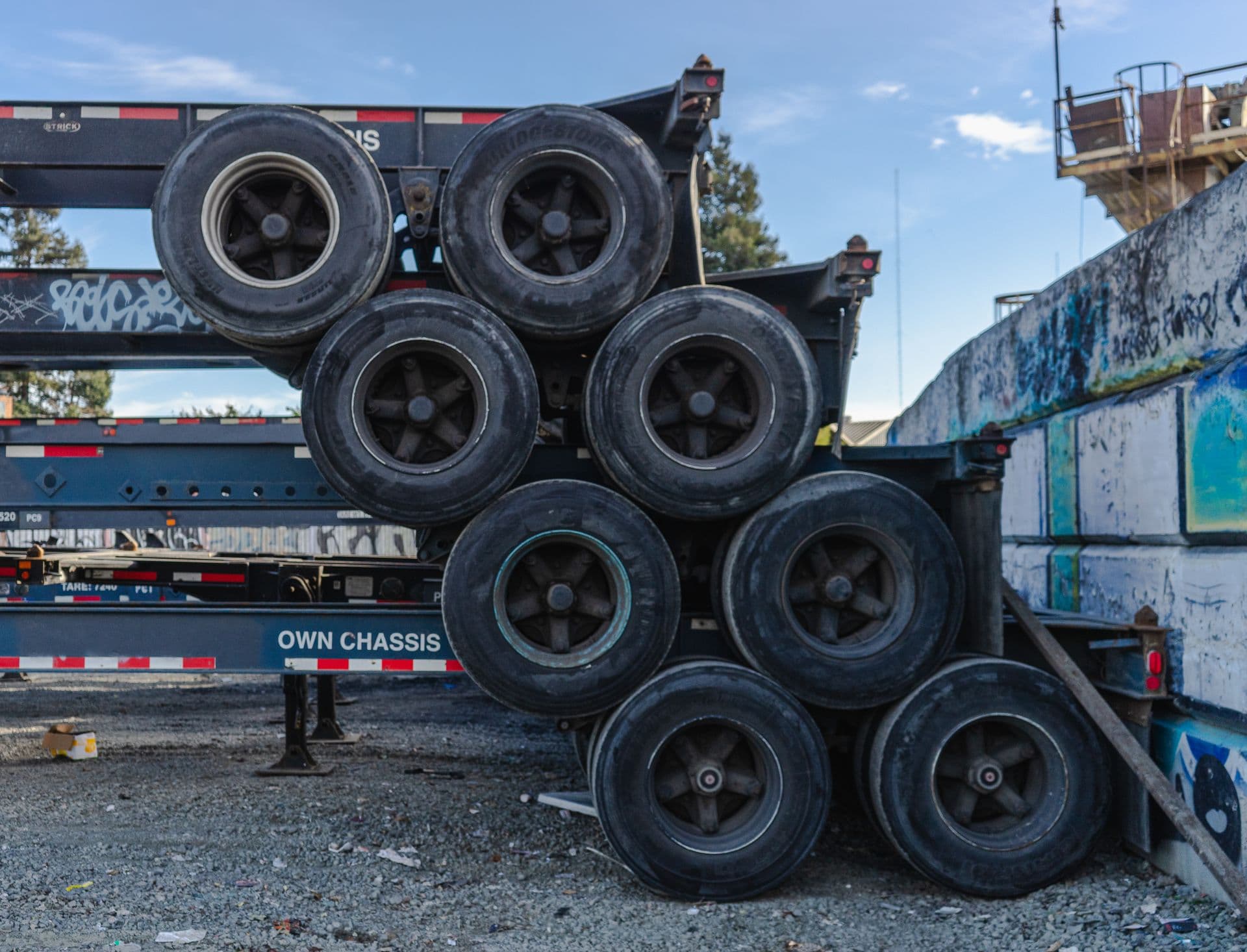
A standard chassis spreads a container's weight across two axles at the rear. Add a third axle and you spread that same weight across more contact points on the road, which lowers the load carried per axle and brings a heavy box back within legal limits for its configuration. That's the whole purpose of a tri-axle chassis: it doesn't change how much the container weighs, it changes how that weight is distributed so the rig can legally carry it.
Tri-axle equipment isn't interchangeable with a standard chassis on demand. It has to be requested and matched to the container ahead of time, because swapping equipment mid-move means backtracking to a chassis pool or terminal, which eats the day. For a rundown of how chassis types differ and when each one applies, see our guide to container chassis basics.
The permitting process, qualitatively
When a load exceeds the legal weight for standard equipment on a given route, it needs an overweight permit before it moves. In practice, that means identifying the exact weight and axle configuration, confirming a route that can legally carry it — sticking to approved heavy corridors rather than whatever path is shortest — and securing the permit before the truck leaves the terminal, not while it's already rolling.
Permitted routes exist because not every road, bridge, or interchange is rated for the same loads. A route that works for one overweight move might not work for another, depending on the exact weight and axle spread. This is also where specialized equipment planning overlaps with permitting — if your cargo is oversized as well as overweight, or needs other special handling, it falls under the same kind of planning we cover on our specialized freight page.
Why accurate weight declarations matter
The container's weight has to be known before the truck shows up, not discovered at the scale. An inaccurate or missing weight declaration creates real problems:
- Wrong equipment gets dispatched. A standard chassis sent for what turns out to be an overweight box means the truck has to turn around and come back with the right gear.
- Permits can't be pulled in time. Overweight permits take lead time to arrange; a surprise at the scale means the load sits until the paperwork catches up.
- Citations and fines. Moving an overweight load without the correct permit and configuration is a compliance violation, not just an inconvenience.
- Schedule slippage. A held load at the scale pushes back everything downstream — the terminal appointment, the delivery window, and any connecting moves.
Accurate weight starts with the shipper or forwarder passing along real numbers, not estimates. Bill of lading weights, VGM (verified gross mass) figures, and any packing list data all help build a clear picture before the truck is booked. It's the same principle we lay out in our drayage quote checklist: the more accurate the information up front, the fewer surprises later.
What happens at the scale
Loaded trucks moving in and around California ports and rail ramps are subject to weight checks, and an overweight rig without the proper permit can be held right there until it's sorted out. That might mean waiting for a permit to be issued, arranging a different chassis, or in some cases having weight redistributed or partially offloaded. None of those options are fast, and all of them are avoidable with planning done before the container leaves the yard.
The Avtar Freightways take
We'd rather have the conversation about container weight before the truck is dispatched than after it's sitting at a scale. Tell us the actual weight when you book, and we'll put it on a tri-axle chassis and route it correctly the first time — no guesswork, no held loads.
Getting it right from the start
Overweight containers aren't a special case that requires reinventing your process — they're a routine variation that just needs the right inputs early. In practice, that comes down to a short sequence:
- 01Get the real container weight from the shipper, forwarder, or VGM documentation before booking.
- 02Flag the load as overweight when you request a quote so the right chassis is reserved.
- 03Confirm whether a permit and approved route are required for the specific weight and destination.
- 04Have the tri-axle chassis and permit ready before the truck leaves the terminal, not after.
Our dispatch team is available 24/7 to sort through weight questions before they become scale-house problems, and our GPS-tracked, ELD-equipped fleet means you can follow a move in real time once it's on the road through our tracking page. If you've got an overweight container moving through the Port of Oakland or a Northern California rail ramp, request a quote with the actual weight and we'll handle the equipment and routing from there.
Moving containers through Oakland?
Call (209) 459-5856 — dispatch answers 24/7 — or get a quote online.
Keep reading
Related guides

Ready when you are — 24/7
Have a container on the water?
Send the details before it hits the port. We'll have a truck, a chassis, and a plan waiting at the terminal.